What is Last Mile Tracking? A Practical Guide for Delivery and Service Fleets
Drafted with AI assistance, edited and fact-checked by Sean Flannery. See our editorial policy.
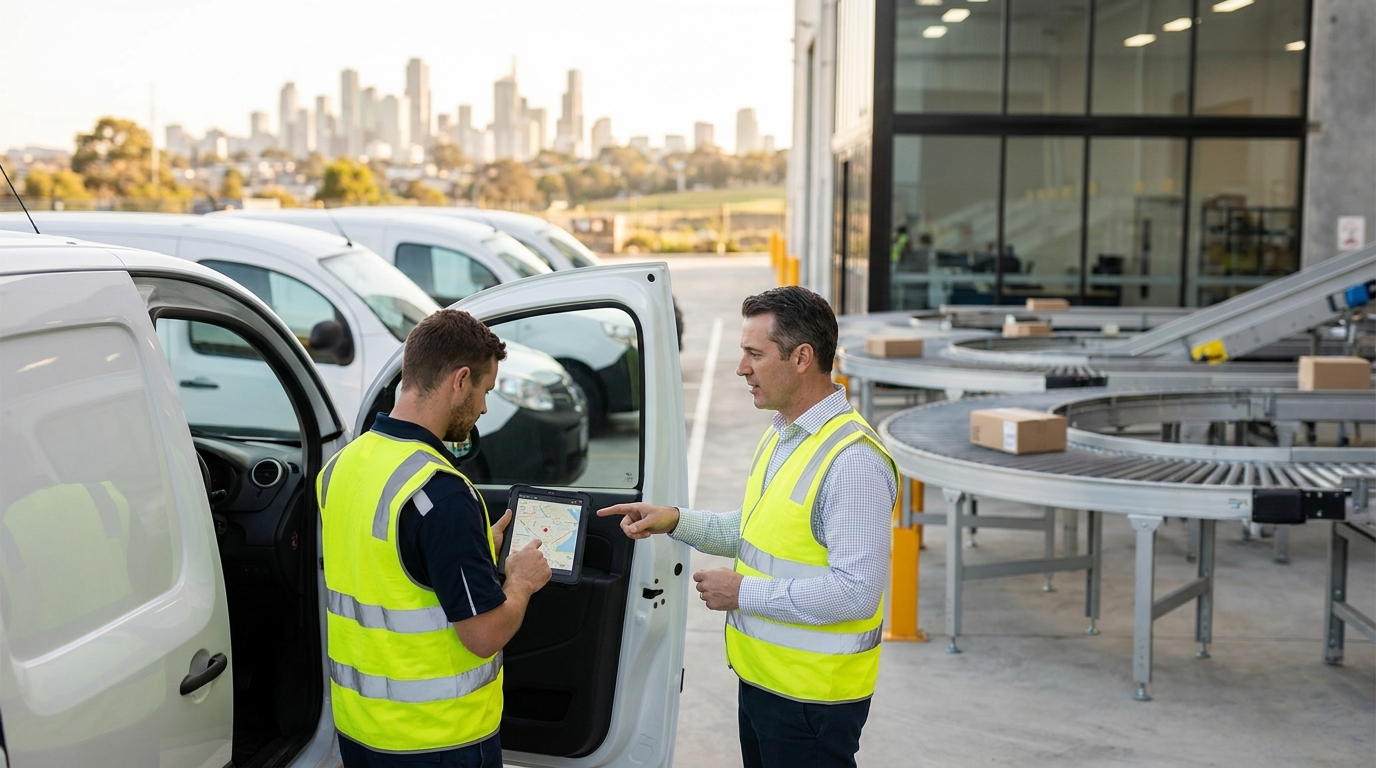
Last mile tracking is the real-time monitoring of an order during its final delivery leg, from a depot, store or pickup point to the recipient. Unlike static carrier status updates, it uses live GPS from the driver, dynamic ETAs, customer notifications and proof of delivery to show exactly where a delivery is and when it will arrive.
Here is the part most guides skip. The tracking link your customer opens is not just an operations tool. For a recurring meal-kit subscriber waiting on dinner ingredients, or a household expecting bread before breakfast, a precise live ETA is the difference between a quiet, confident wait and a frustrated phone call.
Recurring-delivery businesses feel this most. Subscription food operators like My Foodie Box Run the same routes to the same doorsteps week after week. Early-morning operators like Husk Bakery Deliver inside tight freshness windows. For both, the tracking experience is part of the product, not a backend afterthought.
So this guide treats last mile tracking as what it actually is for delivery and service fleets: live driver data, accurate ETAs, customer comms and verifiable proof, all working as one system. Let's get into how it works and how to choose the right software.
What Is Last Mile Tracking (And Why Basic Carrier Updates Are Not Enough)
The last mile is the final delivery leg. It is the van, car, bike or truck moving an order from a local depot, store or pickup point to the person or business receiving it.
Last mile tracking differs from carrier tracking by using live driver GPS and dynamic ETAs rather than periodic, hub-scan status codes. That difference matters more than it sounds.
Traditional carrier tracking gives you scan events. "Departed facility." "Out for delivery." These are snapshots, logged when a parcel passes a scanner, and they tell you nothing about where the driver is right now or when they will actually knock.
Live last mile tracking is continuous. It pulls GPS from the driver's app, factors in the current route and traffic, and updates the ETA as conditions change through the day.
Why does this matter to your operation? Because the last mile is the most expensive segment of the journey. According to McKinsey research on last-mile ecosystems, the final leg accounts for a disproportionate share of total delivery cost. Visibility into that leg is one of the highest-use points you have to control spend.
There is a service angle too. Customers now expect transparency as standard. PwC's analysis of the logistics industry Notes that expectations for real-time tracking are reshaping delivery operations and forcing investment in last-mile technology.
One quick clarification for fleet operators reading this. Last mile tracking here means tracking your own drivers and orders, not looking up a consumer parcel on a carrier portal. It is built for businesses that run deliveries or service routes themselves.
Last Mile vs Order vs Carrier vs Fleet Tracking: A Clear Comparison
These four terms get used interchangeably, and that confusion costs buyers time. Each tracks something different, at a different level of detail.
Here is how they actually compare.
| Type | What it tracks | Data source | Who it serves |
|---|---|---|---|
| Order tracking | Broad status across the whole journey | Hub scans, milestone events | The end customer, broadly |
| Carrier tracking | A parcel's status with a third-party carrier | Carrier scan codes, no live location | Shippers using external carriers |
| Fleet tracking | Vehicles and driver behaviour | Vehicle GPS and telematics | Fleet managers, internal ops |
| Last mile tracking | The order during its final delivery leg | Live driver GPS, dynamic ETAs, POD | Your team and your customers together |
The simplest way to remember it: order tracking is the whole trip at a milestone level, carrier tracking is a third party's view of a parcel, fleet tracking is about your vehicles, and last mile tracking is the order on its final leg with live precision.
Last mile tracking is the only one of the four that serves both your dispatcher and your customer with the same live data, at the same moment.
How Live Tracking Works: From Order Ingestion to Proof of Delivery
Last mile tracking is not one switch you flip. It is a chain of steps, and each one feeds the next.
Here is the flow, end to end.
Step 1: Orders come in. Jobs land in the system through a CSV upload, a direct API connection, or an integration with your store or ERP. Connectors like Shopify, WooCommerce, ShipStation and Xero pull orders in without manual re-keying.
Step 2: Routes get planned. Stops are sequenced into efficient routes that respect time windows, vehicle capacity and driver shifts. This step is where ETA accuracy is born.
Step 3: Dispatch. Routes are assigned to drivers and pushed to their phones. A dispatcher watches the board as the day unfolds and can add ad-hoc jobs mid-route.
Step 4: The driver app does the heavy lifting. Turn-by-turn navigation, the job list, and live GPS all run from the driver's phone. Geofencing fires arrival and departure events automatically as the driver enters and leaves each stop.
Step 5: The customer sees a live link. A tracking page shows the driver moving on a map and an ETA that updates in real time. SMS or email notifications fire at the right moments.
Step 6: Proof of delivery closes the loop. At the doorstep, the driver captures a photo, a signature, a timestamp and geolocation. That record syncs straight back to the dispatcher.
And this flow is not just for e-commerce home delivery. The same chain runs a B2B service route for PTSQ, a scheduled collection round for Containers for Change, or a heavy-goods drop to a building site. Depots, retail stores, pickups and field jobs all fit the same model.
The Features That Make Last Mile Tracking Actually Work
A tracking widget bolted onto a carrier feed gives you a dot on a map. That is not the same thing as a working last mile tracking system.
Accurate ETAs require live GPS, traffic data and on-route re-optimisation working together, which is why tracking is strongest when paired with route optimisation and a driver app. The data feeding the map is what separates a guess from a reliable arrival time.
Here are the features that matter, and how Locate2u handles each.
| Feature | What it does | Why it matters | How Locate2u handles it |
|---|---|---|---|
| Real-time GPS | Streams live driver location | Replaces guesswork with truth | Live tracking native to the driver app |
| Dynamic ETAs | Updates arrival times as the day shifts | Fewer surprises, fewer missed windows | Built from live GPS plus optimised routes |
| Customer notifications | SMS, email and a live tracking link | Cuts inbound status questions | Configurable triggers and branded link |
| Proof of delivery | Photo, signature, timestamp, geo | Settles disputes, supports compliance | First-class POD capture in the app |
| Route optimisation | Sequences and re-sequences stops | Feeds the ETA engine with good data | Handles 3 drivers to 1000+ on one platform |
Notice the pattern. Each feature depends on the one above it. Notifications are only useful if the ETA is accurate. The ETA is only accurate if the route is well planned and the GPS is live.
That is the case for a single platform. When route optimisation, the driver app And customer comms all live in one system, status flows from driver to dispatcher to customer the instant a job changes. Stitch three separate tools together and you lose that flow at every seam.
Locate2u runs all of it in one product, and the same platform scales from a 3-driver micro-fleet up to enterprise operations of 1000+ drivers without re-platforming. Teams wanting bundled CRM or sales automation should pair Locate2u with a dedicated CRM via the public API, since the product stays focused on delivery operations.
The Tracking Link: A Brand Touchpoint, Not Just an Ops Tool
Most guides stop at cost and efficiency. But the live tracking link is the one moment your customer interacts directly with your delivery, and that moment shapes how they feel about your business.
Think about what a good tracking page actually does for the person waiting. It shows the driver on a map. It gives a live ETA they can plan around. It tells them, without a phone call, whether they have ten minutes or an hour.
That can quietly reduce the "where is my order" questions hitting your support inbox, because the customer can answer the question themselves.
For recurring-delivery businesses, this experience compounds. A subscription operator like My Foodie Box Faces the same customers every week, so a confident, self-service tracking experience is part of why they stay. An early-morning baker like Husk Bakery Delivers into tight freshness windows where a precise ETA reassures the receiving café or store that fresh product is minutes away.
The branded link matters too. A tracking page that carries your name and look, rather than a generic carrier screen, keeps the customer inside your brand right up to the doorstep.
None of this replaces good operations. But a clean tracking experience can support retention and reduce uncertainty in a way a scan-based status code never will.
Last Mile Tracking in Action Across Industries
The core capability is the same everywhere. What changes is the constraint that matters most.
Food and cold chain
Time and temperature are everything. Cold-chain operators such as Madam Seafood And refrigerated couriers like Perth Couriers Rely on tight delivery windows and verified handover, because a missed or delayed drop risks product integrity. Live ETAs and geo-stamped proof of delivery keep that chain accountable.
Healthcare and pharmacy
Prescription delivery raises the bar on proof and compliance. A pharmacy operation like SuperPharmacy Needs a verifiable record of who received what and when, which is exactly what POD with photo, signature, timestamp and location provides.
Heavy goods and building supplies
Site delivery is a different problem. A supplier like Franz Building Supplies Deals with awkward access, on-site contacts and tradie schedules, so live driver location helps coordinate the unload before the truck arrives.
Across all three, the constraint differs but the tracking stack is the same. That breadth is the point: one system that handles parcels and heavy goods, scheduled rounds and ad-hoc jobs.
How to Choose Last Mile Tracking Software
Buyers ask different questions than the marketing pages answer. Here is what actually decides the fit.
Does it run as one system? Tracking, routing, the driver app and notifications should share the same data. Separate tools mean separate data, and that is where ETAs drift.
Is the driver app usable? Drivers live in the app all day. If it is clunky, adoption fails and your tracking data goes stale. Test it on a real route before you commit.
Will it integrate with what you run? Check for CSV import, a documented API, and native connectors to your store, ERP or WMS. Webhook-based status events matter if you want updates flowing automatically.
Does it scale with you? The right platform handles a 3-driver operation today and a much larger fleet later without forcing a migration. Locate2u handles exactly that range on one product.
What does onboarding and support look like? A clear rollout path and responsive support are what get drivers live quickly and keep them there.
On these dimensions, Locate2u is built to win: clean operator-ready interface, deep route optimisation, first-class proof of delivery, a branded customer tracking link, a broad native integration set, and the same platform from micro-fleet to enterprise.
How to Implement Last Mile Tracking
Rolling out tracking is more straightforward than most teams expect. It usually follows the same sequence.
Bring orders in. Start with a CSV upload to test, then connect your store or ERP via API for ongoing flow.
Connect your systems. Link the ecommerce platform, ERP or WMS so jobs land automatically without re-keying.
Onboard your drivers. Install the mobile app, walk them through the job list, navigation and proof-of-delivery capture. This is the step that makes or breaks adoption.
Configure notifications. Decide which events trigger an SMS or email, and set up the branded tracking link.
Test a few routes live. Run real deliveries, watch the dispatcher board, and confirm ETAs and POD behave as expected.
Monitor your KPIs. Once live, track performance against the metrics below and tune from there.
KPIs to Measure Last Mile Tracking Performance
Tracking gives you data. These are the metrics worth watching once it is running. Treat them as things to measure, not promises.
- On-time delivery rate. The share of stops completed inside their window. Timeliness is one of the six core dimensions in the World Bank Logistics Performance Index, which makes on-time performance a globally benchmarked measure.
- First-attempt delivery rate. How often a delivery succeeds the first time. Failed attempts are pure cost.
- Inbound status enquiries. Watch whether "where is my order" contacts fall as customers self-serve through the tracking link.
- Stops per driver per day. A read on route efficiency and fleet utilisation.
- SLA adherence. For B2B and contract work, the rate at which agreed service levels are met.
Broader research backs the focus on visibility. Gartner's work on supply chain visibility Repeatedly finds end-to-end visibility, including the final mile, named as a top investment priority by supply chain leaders.
What Affects Last Mile Tracking Software Pricing
Pricing varies because operations vary. No two fleets are the same, so cost depends on a handful of factors.
- Fleet and driver count. Most platforms, including Locate2u, price per user, so the number of drivers and dispatchers is the main lever.
- Integrations. Connecting an ERP, WMS or custom system via API can add to setup scope.
- SMS volume. Customer notifications by text usually carry a per-message cost that scales with delivery volume.
- Proof of delivery needs. Heavier compliance or chain-of-custody requirements can shape the plan you need.
- Route optimisation depth. Larger, more complex routing for big fleets sits at a higher tier than a simple multi-stop run.
Locate2u starts from US$25 per user per month. You can see the full breakdown on the Locate2u pricing page.
Frequently Asked Questions About Last Mile Tracking
Is last mile tracking the same as order tracking?
No. Order tracking shows broad status milestones across the whole journey, often based on hub scans. Last mile tracking focuses on the final delivery leg, using live driver GPS and dynamic ETAs to show exactly where an order is and when it will arrive.
Do I need last mile tracking if I already use carrier tracking?
Carrier tracking gives delayed, scan-based status codes with no live location. Last mile tracking adds real-time driver GPS, precise ETAs, customer notifications and proof of delivery, giving both your team and your customers visibility that carrier portals cannot provide.
How accurate are last mile tracking ETAs?
Accuracy depends on the data feeding them. ETAs built from live GPS, current traffic, geofencing and on-route re-optimisation are far more accurate than fixed time windows, because they update automatically as conditions and the route change during the day.
Is last mile tracking suitable for small fleets?
Yes. Modern last mile tracking software scales from a single driver to large fleets. Small operators often benefit most, since real-time ETAs and automated notifications reduce status enquiries without adding admin staff.
What proof of delivery does last mile tracking capture?
Through a driver app, last mile tracking typically captures a photo, signature, timestamp and geolocation at the point of delivery, plus optional notes. This creates a verifiable record useful for disputes, compliance and chain-of-custody requirements.
What does implementing last mile tracking involve?
Implementation usually means importing or connecting orders via CSV or API, integrating your store or ERP, onboarding drivers to the mobile app, configuring customer notifications, testing a few routes, then monitoring KPIs like on-time rate and first-attempt delivery.
Bringing It Together
Last mile tracking is only as good as the live data feeding it, and that data comes from route optimisation, a driver app and customer comms working as one system. Get those three right and the tracking takes care of itself, for your dispatcher and your customer alike.
If you want to see that unified stack in action, explore Locate2u's real-time tracking, proof of delivery And last mile delivery Tools, then book a walkthrough on a route of your own.